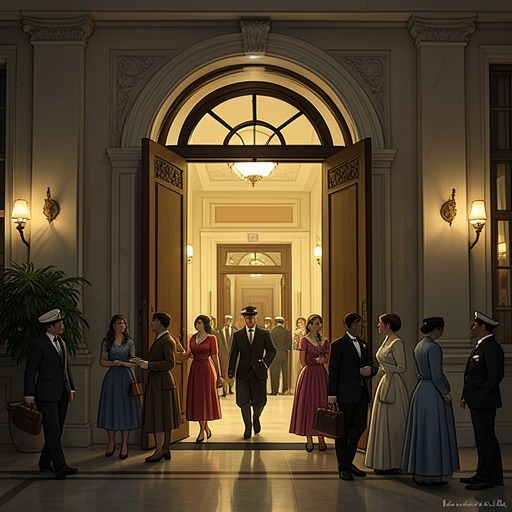
Balbec Grand Hotel manager
In Search of Lost TimeThe Balbec Grand Hotel manager combines authority over the hotel’s daily operations with a conspicuously unreliable command of language. His concern for guests and staff is filtered through practical self-interest and verbal errors, but those errors sometimes carry information the narrator could not otherwise have learned. In particular, the manager’s account of the narrator’s grandmother’s illness turns an apparently comic character into an unwitting witness to concealed suffering.
Position and Manner
The manager oversees the narrator’s room and the hotel’s staff, speaking with the confidence of someone accustomed to giving orders. When the narrator falls ill, he accepts the request that no one enter the room and that the narrator remain in bed. He is pleased that the narrator refuses an offer to obtain medicine, because he fears the smell might disturb other guests. His attention to the hotel’s reputation and routine sits beside an accommodating manner: he offers food and drink, and makes clear that he can influence decisions concerning the staff.
His speech repeatedly substitutes one word for another. He praises the narrator as being “in the movement,” meaning that he is in the right, and garbles expressions about the door lock, punishment, wine, and food. The mistakes are not simply decorative: they establish a comic mismatch between his forceful manner and his uncertain vocabulary. The narrator listens closely, interpreting the intended meanings while registering the odd words themselves.
Encounters with the Narrator
The manager’s authority is especially apparent when the narrator gives instructions about visitors. He is told that Albertine is expected and asked to have her wait in the drawing-room. In the course of conversation, he remarks that he has known Albertine and her friends for years, but complains about things they have said concerning the hotel. His muddled remarks about their having reached an “age of purity” and being “illegitimate” prompt the narrator to infer that he means puberty and to puzzle over the second word. The scene gives the manager a store of local familiarity, though his account of it is as linguistically unstable as his other observations.
His relation to the narrator is also shaped by the hotel’s hierarchy of service. He promises that the narrator’s wishes about the staff will be ratified, presenting himself as able to make the narrator’s preferences effective. But the narrator’s later discovery that the lift-boy’s distress arose because he had missed the customary five-franc tip complicates the comfort of this authority. The manager’s promise to carry out the narrator’s wishes belongs to a world in which money, rank, and service govern interactions; the narrator’s reading of the lift-boy’s apparent devotion is itself unsettled by that discovery.
The Grandmother’s Illness
After the narrator has spent the day looking at his grandmother’s photograph, the manager visits and offers condolences. He then recalls that the grandmother had suffered syncopes at the hotel. Concerned that an episode might damage the establishment’s reputation with other guests, he had thought she ought to leave; she asked him to keep the matter quiet and promised that it would not happen again. A floor waiter later reported another episode, but the manager says the hotel tolerated the situation because the family were longstanding clients and no guest had complained.
The disclosure alters the meaning of the narrator’s memories. His grandmother had kept the episodes from him, perhaps because she was trying not to trouble or irritate him and to avoid being made to leave. The manager’s mistaken pronunciation of “sincup” remains painfully fixed in the narrator’s mind: a comic verbal slip becomes inseparable from the belated knowledge it delivers. The manager does not intend to expose a family secret, yet his account reveals the distance between the grandmother’s hidden condition and the grandson’s understanding of it.
Narrative Role
The manager’s scenes repeatedly make imperfect language a vehicle for otherwise unavailable knowledge. His errors invite the narrator’s interpretation, sometimes with amusement, but the account of the grandmother’s fainting spells changes the emotional weight of the same device. A mispronounced word can be ridiculous in one moment and, once attached to a loved person’s suffering, almost unbearable in the next.
He is neither a confidant nor a deliberate truth-teller. His disclosures emerge from hotel business: concern about other guests, the establishment’s reputation, and the family’s status as returning clients. That practical perspective supplies evidence the narrator lacked, while also exposing the limits of what any observer can know. The manager’s brief recollection therefore becomes a turning point in the narrator’s belated recognition of his grandmother’s illness and of what she had concealed from him.